FOOT
NOTES

this website...
(
)
by holding a finger on the lower part of the screen
Continue
to make it loose
(
)
INTRODUCTION

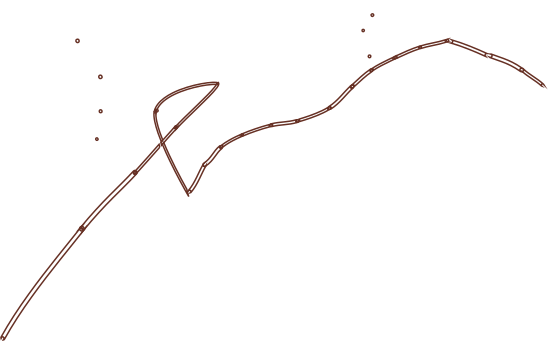
One step after another
Mona Ortner & Helen Hausdorf
Walking teaches us where we belong. It is a form of noticing, revealing systems we don't usually see, reminding us of our speed, our place in a web of interrelations with environment, society, community. It sets our thoughts free, putting us out into the world, in relation to it, to each other, to ourselves. We live in a moment where digital technologies touch almost every part of our everyday life, our work, our forms of togetherness. Our eyes fly over screens. Our ears take in information. Bodily movement is reduced to fingertips drumming on keyboards, thumbs swiping, scrolling, clicking. More and more aspects of our lives, including our bodies, are measured, quantified, analysed. Can you also feel your body glitching after too much time in front of a screen? Distracted and disconnected, not only from each other, but from our senses, our bodies, and thought processes that can't be pushed, grasped, or put into order, the rhythm and speed of walking, just walking, become almost a slow protest. Putting one foot in front of the other turns into a counter-act against a digital environment where the traces we leave with our thumbs on slippery displays become profit, and our attention a commodity. Walking can weave our thoughts to the landscape we move through, opening a space where thinking, perception, and exchange happen differently. Most digital applications are designed to be fast, immediate and remove friction. Walking has its own own beat and pace, ones we can't simply scroll past. Making space for the unpredictable to enter might mean to slow down on purpose, to stand impatience and to get lost And so, this leaflet holds a map of scores: short notations, prompts for movement and thought, gathered along the way. It won't show you the right path, or help you find a particular place. Take it instead as an invitation to make a step on a stony surface, rather than a swipe on a polished screen. You are surrounded by scores that can serve as starting points for thought while you walk, meander, and let your mind drift.
Tracing a headland
Rebecca Solnit
Where does it start? Muscles tense. One leg a pillar, holding the body upright between the earth and sky. The other a pendulum, swinging from behind. Heel touches down. The whole weight of the body rolls forward onto the ball of the foot. The big toe pushes off, and the delicately balanced weight of the body shifts again. The legs reverse position. It starts with a step and then another step and then another that add up like taps on a drum to a rhythm, the rhythm of walking. The most obvious and the most obscure thing in the world, this walking that wanders so readily into religion, philosophy, landscape, urban policy, anatomy, allegory, and heartbreak. The history of walking is an unwritten, secret history whose fragments can be found in a thousand unemphatic passages in books, as well as in songs, streets, and almost everyone's adventures. The bodily history of walking is that of bipedal evolution and human anatomy. Most of the time walking is merely practical, the unconsidered locomotive means between two sites. To make walking into an investigation, a ritual, a meditation, is a special subset of walking, physiologically like and philosophically unlike the way the mail carrier brings the mail and the office worker reaches the train. Which is to say that the subject of walking is, in some sense, about how we invest universal acts with particular meanings. Like eating or breathing, it can be invested with wildly different cultural meanings, from the erotic to the spiritual, from the revolutionary to the artistic. Here this Seite 4: history begins to become part of the history of the imagination and the culture, of what kind of pleasure, freedom, and meaning are pursued at different times by different kinds of walks and walkers. That imagination has both shaped and been shaped by the spaces it passes through on two feet. Walking has created paths, roads, trade routes; generated local and cross-continental senses of place; shaped cities, parks, generated maps, guidebooks, gear, and, further afield, a vast library of walking stories and poems, of pilgrimages, mountaineering expeditions, meanders, and summer picnics. The landscapes, urban and rural, gestate the stories and the stories bring us back to the sites of this history. This history of walking is an amateur history, just as walking is an amateur act. To use a walking metaphor, it trespasses through everybody else's field—through anatomy, anthropology, architecture, gardening, geography, political and cultural history, literature, sexuality, religious studies—and doesn't stop in any of them on its long route. For if a field of expertise can be imagined as a real field— a nice rectangular confine carefully tilled and yielding a specific crop—then the subject of walking resembles walking itself in its lack of confines. And though the history of walking is, as part of all these fields and everyone's experience, virtu ally infinite, this history of walking I am writing can only be partial, an idiosyncratic path traced through them by one walker, with much doubling back an looking around. In what follows, I have tried to trace the paths that brought most of us in my country, the United States, into the present moment, a history compounded largely of European sources, inflected and subverted by the vastly different scale of American space, the centuries of adaptation and mutation here and by the other traditions that have recently met up with those paths, notably Asian traditions. The history of walking is everyone's history, and any written version can only hope to indicate some of the more well-trodden paths in the author's vicinity—which is to say, the paths I trace are not the only paths. I sat down one spring day to write about walking and stood up again, because a desk is no place to think on the large scale. In a headland just north of the Golde Gate Bridge studded with abandoned military fortifications, I went out walking up a valley and along a ridgeline, then down to the Pacific. [...]
The Mind at Three Miles an Hour
Rebecca Solnit
I. Pedestrian Architecture Jean-Jacques Rousseau remarked in his _Confessions_, “I can only meditate when I am walking. When I stop, I cease to think; my mind only works with my legs.” The history of walking goes back further than the history of human beings, but the history of walking as a conscious cultural act rather than a means to an end is only a few centuries old in Europe, and Rousseau stands at its beginning. That history began with the walks of various characters in the eighteenth century, but the more literary among them strove to consecrate walking by tracing it to Greece, whose practices were so happily revered and misrepresented then. The eccentric English revolutionary and writer John Thelwall wrote a massive, turgid book, _The Peripatetic_, uniting Rousseauian romanticism with this spurious classical tradition. “In one respect, at least, I may boast of a resemblance to the simplicity of the ancient sages; I pursue my meditations on foot,” he remarked. And after Thelwall’s book appeared in 1793, many more would make the claim until it became an established idea that the ancients walked to think, so much so that the very picture seems part of cultural history: austerely draped men speaking gravely as they pace through a dry Mediterranean landscape punctuated with the occasional marble column. This belief arose from a coincidence of architecture and language. When Aristotle was ready to set up a school in Athens, the city assigned him a plot of land. **Seite 15** “In it,” explains Felix Grayeff’s history of this school, “stood shrines to Apollo and the Muses, and perhaps other smaller buildings. . . . A covered colonnade led to the temple of Apollo, or perhaps connected the temple with the shrine of the Muses; whether it had existed before or was only built now, is not known. This colonnade or walk (_peripatos_) gave the school its name; it seems that it was here, at least at the beginning, that the pupils assembled and the teachers gave their lectures. Here they wandered to and fro; for this reason it was later said that Aristotle himself lectured and taught while walking up and down.” The philosophers who came from it were called the Peripatetic philosophers or the Peripatetic school, and in English the word _peripatetic_ means “one who walks habitually and extensively.” Thus their name links thinking with walking. There is something more to this than the coincidence that established a school of philosophy in a temple of Apollo with a long colonnade—slightly more. The Sophists, the philosophers who dominated Athenian life before Socrates, Plato, and Aristotle, were famously wanderers who often taught in the grove where Aristotle’s school would be located. Plato’s assault on the Sophists was so furious that the words _sophist_ and _sophistry_ are still synonymous with deception and guile, though the root _sophia_ has to do with wisdom. The Sophists, however, functioned something like the chautauquas and public lecturers in nineteenth-century America, who went from place to place delivering talks to audiences hungry for information and ideas. Though they taught rhetoric as a tool of political power, and the ability to persuade and argue was crucial to Greek democracy, the Sophists taught other things besides. Plato, whose half-fabricated character Socrates is one of the wiliest and most persuasive debaters of all times, is somewhat disingenuous when he attacks the Sophists. Whether or not the Sophists were virtuous, they were often mobile, as are many of those whose first loyalty is to ideas. It may be that loyalty to something as immaterial as ideas sets thinkers apart from those whose loyalty is tied to people and locale, for the loyalty that ties down the latter will often drive the former from place to place. It is an attachment that requires detachment. Too, ideas are not as reliable or popular a crop as, say, corn, and those who cultivate them often must keep moving in pursuit of support as well as truth. Many professions in many cultures, from musicians to medics, have been nomadic, possessed of a kind of diplomatic immunity to the strife between communities that keeps others local. [...]
This is an extract from "The Mind at Three Miles an Hour" from: Solnit, R. (2022). Wanderlust: A history of walking. Granta Publications. Page 14 – 15
Wanderers - a History of Women Walking
Kerri Andrews
THIS IS A BOOK about women who have, over the past three hundred years, found walking essential to their sense of themselves as women, writers and people. The history of walking has always been women’s history, though you would not know it from what has been published on the subject. Since Jean-Jacques Rousseau’s The Reveries of a Solitary Walker appeared in 1782, walking has been acknowledged as central to the writing of many famous male authors: William Wordsworth, Samuel Taylor Coleridge, Thomas De Quincey, John Keats, John Clare and others. These writers gained readers in their own time, and have continued to enjoy admiration since, not only for their literary accomplishments but their physical feats: De Quincey estimated that William Wordsworth walked 180,000 miles in his lifetime on what he understatedly described as ‘serviceable legs beyond the average standard of human requisition’.1 De Quincey himself is supposed to have walked an average of 70–100 miles every week, and Keats covered 642 miles in around two months while touring the Lake District and Scotland in 1818.2 So closely were Romantic writers’ reputations tied to their pedestrian exploits that walking has come to be held as the ideal means by which a poet can experience ‘the spontaneous overflow of powerful feelings’ William Wordsworth considered necessary for composition.3 Many have followed: Leslie Stephen, Henry David Thoreau, Friedrich Nietzsche, Emmanuel Kant, Robert Louis Stevenson, Edward Thomas, Werner Herzog, Robert Macfarlane. When these men write about their walking, they look back to earlier male walker-writers; even the most recent accounts of walking, such as Robert Macfarlane’s The Old Ways (2012), refer mainly to other male walker-writers (with just the one exception in Macfarlane’s case: his championing of Nan Shepherd’s prose poetry about the Cairngorms, The Living Mountain). So utterly has writing about walking been dominated by men that Rebecca Solnit has described it, with some bitterness, as a kind of club, ‘not one of the real walking clubs, but a kind of implicit club of shared background’, where the members ‘are always male’.4 The 2014 reissue of the popular anthology While Wandering: Words on Walking rather proves Solnit’s point: the ‘words on walking’ are male-authored more than 90 per cent of the time; of around 270 entries, just 26 are written by women. Also underlining the validity of Solnit’s claim is Frédéric Gros’ A Philosophy of Walking (2014), which calls exclusively on examples of male walkers; the sole mention of a woman walker occurs, in passing, on the penultimate page. The universality of the title belies the fact that the book itself explores a philosophy of male walking, both in terms of subject-matter and in the pronouns used to describe the person walking – a generalized individual who is labelled throughout as ‘he’. While this is possibly an unfortunate effect of the book’s translation from French – with its gendered nouns – into English, it hammers home the apparent, and seemingly overwhelming, masculinity of walking. In describing Gros’ book in an article for the The Guardian, Carole Cadwalladr notes that ‘it’s an examination of the philosophy of various thinkers for whom walking was central to their work – Nietzsche, Rimbaud, Kant, Rousseau, Thoreau (they’re all men; it’s unclear if women don’t walk or don’t think).’5
This is an extract from Andrews, K. (2020). Wanderers: A history of women walking. Reaktion Books.
The Mind at Three Miles an Hour
Rebecca Solnit
I. Pedestrian Architecture Jean-Jacques Rousseau remarked in his _Confessions_, “I can only meditate when I am walking. When I stop, I cease to think; my mind only works with my legs.” The history of walking goes back further than the history of human beings, but the history of walking as a conscious cultural act rather than a means to an end is only a few centuries old in Europe, and Rousseau stands at its beginning. That history began with the walks of various characters in the eighteenth century, but the more literary among them strove to consecrate walking by tracing it to Greece, whose practices were so happily revered and misrepresented then. The eccentric English revolutionary and writer John Thelwall wrote a massive, turgid book, _The Peripatetic_, uniting Rousseauian romanticism with this spurious classical tradition. “In one respect, at least, I may boast of a resemblance to the simplicity of the ancient sages; I pursue my meditations on foot,” he remarked. And after Thelwall’s book appeared in 1793, many more would make the claim until it became an established idea that the ancients walked to think, so much so that the very picture seems part of cultural history: austerely draped men speaking gravely as they pace through a dry Mediterranean landscape punctuated with the occasional marble column. This belief arose from a coincidence of architecture and language. When Aristotle was ready to set up a school in Athens, the city assigned him a plot of land. **Seite 15** “In it,” explains Felix Grayeff’s history of this school, “stood shrines to Apollo and the Muses, and perhaps other smaller buildings. . . . A covered colonnade led to the temple of Apollo, or perhaps connected the temple with the shrine of the Muses; whether it had existed before or was only built now, is not known. This colonnade or walk (_peripatos_) gave the school its name; it seems that it was here, at least at the beginning, that the pupils assembled and the teachers gave their lectures. Here they wandered to and fro; for this reason it was later said that Aristotle himself lectured and taught while walking up and down.” The philosophers who came from it were called the Peripatetic philosophers or the Peripatetic school, and in English the word _peripatetic_ means “one who walks habitually and extensively.” Thus their name links thinking with walking. There is something more to this than the coincidence that established a school of philosophy in a temple of Apollo with a long colonnade—slightly more. The Sophists, the philosophers who dominated Athenian life before Socrates, Plato, and Aristotle, were famously wanderers who often taught in the grove where Aristotle’s school would be located. Plato’s assault on the Sophists was so furious that the words _sophist_ and _sophistry_ are still synonymous with deception and guile, though the root _sophia_ has to do with wisdom. The Sophists, however, functioned something like the chautauquas and public lecturers in nineteenth-century America, who went from place to place delivering talks to audiences hungry for information and ideas. Though they taught rhetoric as a tool of political power, and the ability to persuade and argue was crucial to Greek democracy, the Sophists taught other things besides. Plato, whose half-fabricated character Socrates is one of the wiliest and most persuasive debaters of all times, is somewhat disingenuous when he attacks the Sophists. Whether or not the Sophists were virtuous, they were often mobile, as are many of those whose first loyalty is to ideas. It may be that loyalty to something as immaterial as ideas sets thinkers apart from those whose loyalty is tied to people and locale, for the loyalty that ties down the latter will often drive the former from place to place. It is an attachment that requires detachment. Too, ideas are not as reliable or popular a crop as, say, corn, and those who cultivate them often must keep moving in pursuit of support as well as truth. Many professions in many cultures, from musicians to medics, have been nomadic, possessed of a kind of diplomatic immunity to the strife between communities that keeps others local. [...]
This is an extract from "The Mind at Three Miles an Hour" from: Solnit, R. (2022). Wanderlust: A history of walking. Granta Publications. Page 14 – 15
The Positive Effect of Walking on Creative Thinking
Kerri Andrews
This is an extract from Andrews, K. (2020). Wanderers: A history of women walking. Reaktion Books.